On Knowing Who You Are
Remembering Diana Conway, a fiercely independent woman who lived unapologetically and completely.

When I was a teenager, a life-sized, nude statue of my mother stood in the living room of our split-level Anchorage home. The ceramic sculpture was jet black and anatomically accurate, posed in the corner with a cocked hip and two pert nipples.
“Is that your mom?” my friends would whisper with a mix of awe and confusion upon entering the house for the first time.
This was infinitely mortifying. Sometimes I would throw a blanket over the statue’s head and torso before visitors arrived, praying that nobody would ask about the two black legs visible beneath the blanket on the seventies-era orange carpet.
Years later, I realize how much this said about my mom. Beneath her stoic exterior, she was a free spirit and a child of the sixties, a fiercely independent woman who lived life entirely on her own terms. She never cared about fashion or trends or worrying what other people thought of her. While my friends' moms appeared in JC Penney family portraits, my mom proudly displayed her nude doppelgänger, crafted by the man she always described—to our unending teenage embarrassment—as “my lover.”
My mom knew exactly who she was. She wore her authentic self on her sleeve (when she wore clothes). As a minimalist, she preferred a simple life and wanted for little, but the things she did want, she pursued relentlessly and unapologetically.
When she died last week at the age of eighty-two, I think she left few regrets.
We called her Diana, not “Mom.” It was a Conway family tradition. Her father, Joe, had been a ruggedly handsome Hollywood actor, a flight instructor during World War II, and a high school teacher. He changed the family name from Cohen during the blacklisting of the 1950s to avoid being pegged as a communist.
Ironically, he was a communist.
Her mother, Sally Roe, was an executive assistant and a beauty. Sally raised two children in Southern California: Diana and her brother Michael. Every year, when my brother and I were growing up in Alaska, our mom would trace outlines of our hands on sheets of paper to send to Grandma Sally; months later, perfectly sized knitted mittens would arrive in the mail for winter.
As a girl, Diana was a tomboy and very much her father’s daughter. From him, she learned to play the guitar, speak Spanish, and become politically progressive. She graduated from UCLA with degrees in Spanish and music. She moved to New York City for graduate school and met my father. They married and spent two years in the Peace Corps, running a co-op in a tiny village high up in the Andes mountains of Peru. When she became pregnant with me, in 1968, they returned to New York.
She wanted to have children and she also wanted a PhD, so she did both, schlepping a toddler to the New York Public Library while she completed her dissertation. She wanted to get out of the noisy, crowded city, so she moved her young family to Alaska, the wildest, woolliest, most distant place in America. When she decided to visit China, she didn’t just read guidebooks; she became fluent in Chinese.
In Anchorage, she taught Spanish at the local community college. She played guitar at the local Renaissance Faire, toting her children along dressed in breeches and blouses. She led Hanukkah sing-alongs at our elementary school. During a sabbatical, in 1977, she took the family on a six-month sojourn through South America, homeschooling my brother and me.
After her marriage ended, she found the true love of her life, an artist named Alex Combs who was a fellow teacher at the university. He was twenty-four years her senior and they couldn’t have seemed more different. He was a giant bear of a man; she was tiny. His work was all in the physical world—painting, sculpting, fishing. She was an intellectual—reading, writing, publishing. He had grown up a dirt-poor orphan in Kentucky; she came from a loving family in Los Angeles. And yet, the two of them just fit. They loved each other completely and built a life together that lasted nearly thirty years, until Alex died at age eighty-nine.
Diana was a loving mom, but never a helicopter parent. She gave me and my brother the space to learn from our mistakes and find our true selves. She was never the kind of mom who pushed us toward one career or another, nor expressed disappointment in our life choices. She always seemed proud of who we had become. We felt loved but not overburdened or smothered.
During our teen years, she often taught afternoons or evenings at the university. We were latchkey kids. She taught us to cook for ourselves, do our homework, and be responsible young adults. We didn’t have to ask permission to have friends over or go out. There weren’t many rules, except for the “two-cookie rule,” which mandated that one could have no more than two pieces of dessert. My brother became a juvenile legal scholar, endlessly litigating what exactly constituted a “piece” of dessert.
From Alex, my mom gained a new set of adult stepsons, daughters-in-law, and grandchildren. She loved them and they loved her in return—once they got used to her quirky disposition and disinclination to withhold opinions on child-rearing. She could be an acquired taste as a mother-in-law.
The longest chapter of her life was at Halibut Cove, where she moved after taking early retirement at age forty-five. It was a remote Alaskan island, a colony of artists and fishermen, with no roads or cars, an hour by boat from the nearest town. There, she found her place. The people of Halibut Cove were ruggedly independent, authentic, and outspoken. It was a community of neighbors who always looked out for one another. Nobody locked their doors; in fact, you might come home to find that someone had left a freshly caught salmon in your sink.
It was a place filled with people who knew exactly who they were.
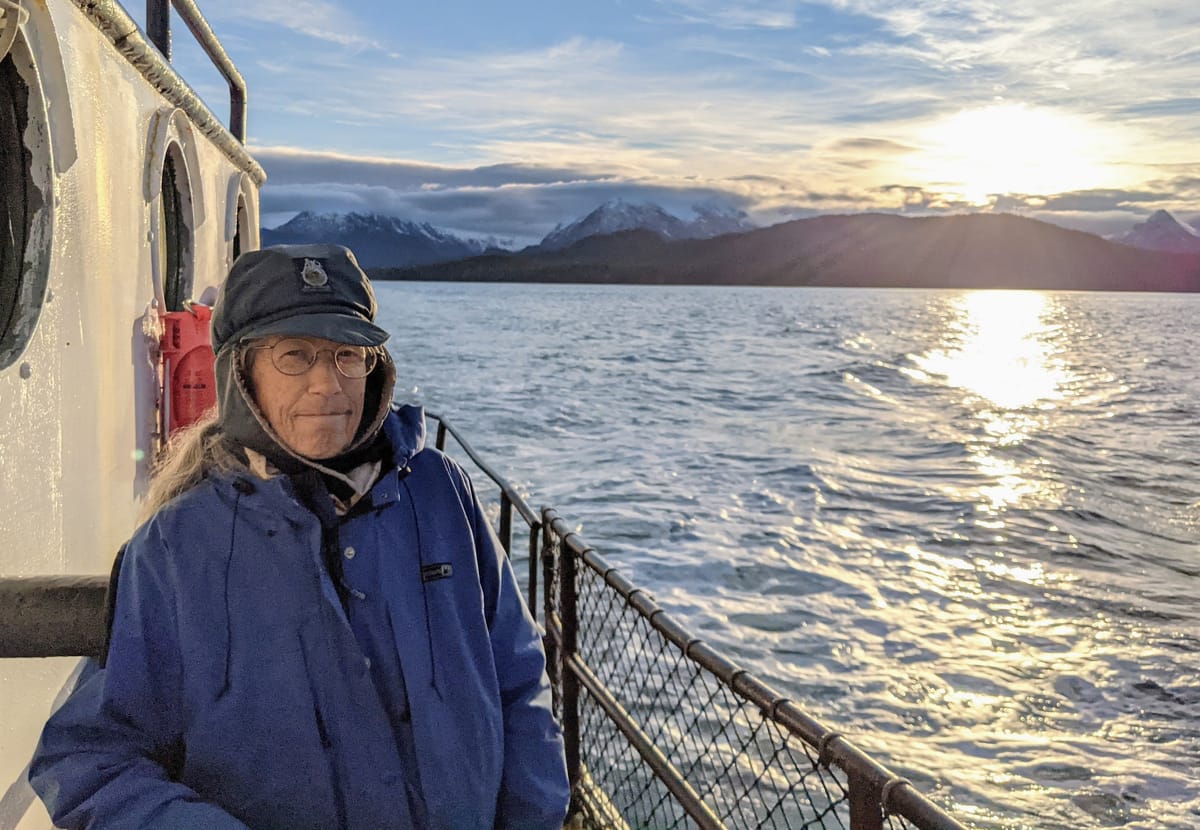
At Halibut Cove, nobody cared when Diana wore a jacket that was four sizes too big or skinny-dipped on the beach. Nobody objected to the ceramic toilet paper holder shaped like an erect penis. On the island, my mother wrote children’s books and a newspaper column, grew vegetables in her garden, and continued her lifelong learning. She walked, every day, all over the small island, scurrying at a pace that belied her tiny legs. Neighbors would see her coming through the woods, singing to keep the bears away, one of her trademark hand-me-down hats perched jauntily on her head.
She was an inveterate collector and beachcomber, always picking up interesting shells or prehistoric arrowheads or flotsam that had blown in on a storm. She could repurpose anything that someone was throwing away. She didn’t believe in waste: not food, nor clothing, nor the rainwater that she collected from her roof in a giant cistern. When she came to visit us at our house in Portland, she would rummage through the back of the fridge to find long-forgotten leftovers, scraping off the mold and making a casserole. Many of her clothes were hand-me-downs from Alex. She’d just roll up the sleeves and tuck a flowing shirttail into her trousers.
She ran clubs and tea parties for children on the island. She’d walk from house to house, dropping in for smoked salmon and crackers and the latest gossip. Every week or two, she’d take the mail boat across Kachemak Bay to the city of Homer to pick up groceries. She never owned a boat of her own, save for a tiny rowboat that she’d use to paddle around the inside of the cove. Even as more and more dirt roads were plowed to make way for motorized carts and ATVs, Diana remained a committed walker.
She and Alex traveled often—to Europe, to Asia, to South America, and to see all of their children and grandchildren—but they always returned to their home at Halibut Cove, to the art-filled living room where they would sit and look out onto the bay and read books quietly next to one another.
Dementia doesn’t arrive boldly, like a heart attack or a stroke. It sneaks in quietly: a missed appointment here, a repeated question there. Diana should have been the poster child for avoiding dementia. She was physically and mentally hale, ate a healthy Mediterranean diet, and even took a new lover after Alex died, a roguish Scotsman named Doug.
But dementia came quietly knocking.
For a time, the community at Halibut Cove helped her to continue navigating life on the island, sending boats to magically appear at the dock in Homer when she confused morning for night. They brought food and made sure she was safe.
But eventually she could stay no longer. At the end of summer 2021, we moved her into an assisted living facility near my brother Jason in Colorado. Within a few months, she was in memory care. Within two years, she no longer reliably recognized her children.
Dementia magnifies one’s personality.
Our eighty-year-old mother insisted that she was ready to have another baby. She declared herself ready to find a new teaching job. When a new resident arrived in memory care who spoke only Spanish, Diana became her translator and confidant.
In later years, when she could no longer speak, she could still sing; Jason would play ukulele and Diana would sing along, remembering the lyrics from her youth. She remained a collector, spiriting rocks and plants and the occasional birdfeeder from the outdoor courtyard into her room. She still walked every day, hurrying at her brisk pace through the halls of the facility, never becoming wheelchair-bound or bedridden like so many of the other patients in memory care. The staff adored her. She remained quintessentially Diana.
The hospice nurse called on New Year’s Eve to say that my mom was “transitioning,” which, it turns out, meant she was dying, not changing gender. She would have rolled her eyes at the euphemism. Diana was a devout atheist, as pragmatic about death as she was about everything in life. Her advance directive had made it clear that she wanted to slip away gracefully when the time came. She left a poem to her sons alongside her will, admonishing us not to say that her soul had gone to heaven, or that she had “passed on” to an afterlife that she very much did not believe in.
Just say that I’ve died, she insisted.
It took three more weeks for her body to give in. The hospice staff said they’d rarely seen someone with advanced dementia remain so physically strong and stubbornly reluctant to go. We sat with her during her final week, holding her hand, singing to her, telling her that we loved her, just in case she could still hear us. On Sunday afternoon, I stepped out of the room for two minutes to make a phone call; when I returned she was gone.
Dementia amortizes grief over time, chipping away the sorrow piece by piece until the end is a relief. Today I choose to remember the strong, independent woman who raised me, not the person who slowly slipped away over the last five years. I wish there were more time, of course, but she left little undone.
Diana lived life on her own terms. She knew who she was and what she wanted. She got to be a mom and a scholar, a lover and a traveler, a daughter and a sister, a poet and a neighbor.
She leaves giant shoes to fill. Not just because of her heart, but also because, if there is an afterlife, she’s speed-walking around in heaven, wearing boots that somebody twice her size left in the lost and found.
In loving memory of Diana Conway, 1943 - 2026